The Ultimate Guide to Sleep Cycles & Better Rest
Understanding the Sleep Calculator & Bedtime Logic
Have you ever slept for nine full hours only to wake up feeling completely exhausted? Or perhaps you slept for a mere six hours and woke up feeling energetic and alert? The key to understanding this phenomenon lies in the science of sleep cycles. Waking up at the correct time is just as important as how many hours of sleep you get. Our sleep calculator is designed to help you synchronize your sleep schedule with your body's natural circadian rhythm.
By computing the exact intervals at which your body transitions between sleep phases, our tool helps you avoid waking up during deep, restorative sleep. Instead, it suggests wake-up times and bedtimes that coincide with the end of a cycle, ensuring you open your eyes during light, easily breakable sleep stages.
The Science Behind Sleep Cycles
When you fall asleep, your brain and body go through a highly structured sequence of recovery stages. A single complete sleep cycle lasts approximately 90 minutes on average for a healthy adult. During this time, your brain transitions through four distinct stages:
- Stage N1 (Light Sleep): This is the transition stage where you drift from wakefulness to sleep. Your brain waves begin to slow, and your muscles relax. This stage lasts just a few minutes.
- Stage N2 (Slightly Deeper Sleep): Heart rate slows and body temperature drops. Brain activity displays bursts of rapid activity known as sleep spindles. You spend about 50% of your total night in this stage.
- Stage N3 (Deep Sleep / Slow-Wave Sleep): This is the most restorative part of sleep. Tissue repair, muscle growth, and immune system rejuvenation occur during this stage. Waking up during N3 causes severe grogginess, known as sleep inertia.
- REM (Rapid Eye Movement) Sleep: Your brain becomes highly active, mirroring waking states. This is when vivid dreaming occurs. REM sleep is critical for memory consolidation, learning, and emotional regulation.
An optimal night of rest consists of completing 5 to 6 full cycles, translating to roughly 7.5 to 9 hours of sleep. Waking up at the tail end of REM or the beginning of Stage N1 ensures that you feel awake and fully refreshed instantly.
How the Sleep Calculator Logic Works (The Formula)
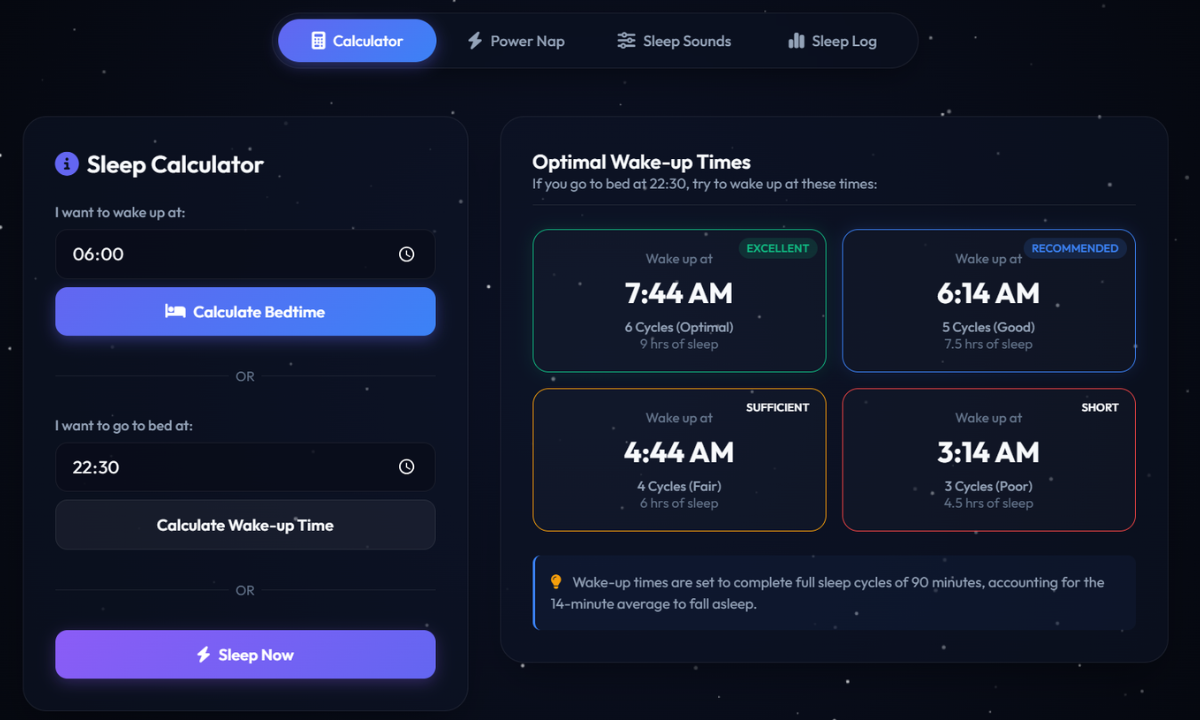
Our tool uses a precise mathematical formula to estimate your ideal times. To provide realistic recommendations, the sleep calculator incorporates an average sleep latency. Research shows that a healthy human takes an average of 14 minutes to transition from fully awake to asleep.
Ideal Bedtime = Target Wake Time - (N * 90 minutes) - 14 minutes (latency)
Ideal Wake-up Time = Bedtime + (N * 90 minutes) + 14 minutes (latency)
Where N represents the number of sleep cycles. The calculator outputs recommendations for 3, 4, 5, and 6 sleep cycles (corresponding to 4.5, 6, 7.5, and 9 hours of sleep plus the 14-minute buffer).
Key Benefits of Sleep Cycle Synchronization
Aligning your routine with your biological rhythm provides massive benefits for your productivity, health, and mental well-being:
- Eliminates Morning Grogginess: By waking at the end of a cycle, you bypass the heavy, disoriented feeling associated with sleep inertia.
- Optimizes Physical Recovery: Securing uninterrupted deep sleep allows your body to complete vital protein synthesis and cellular repair.
- Boosts Cognitive Performance: REM sleep consolidates new information, improving memory recall, logical processing, and creative focus.
- Helps Track Sleep Debt: Using a sleep log lets you monitor if you are accumulating chronic sleep deficits and plan recovery naps.
Frequently Asked Questions (FAQ) About Sleep Cycles
What is the best sleep calculator interval?
The standard interval is 90 minutes per cycle. While this is the biological average for adults, individual cycles can range anywhere from 70 to 110 minutes depending on age, health, and genetics.
How many cycles should I aim for each night?
For most adults, completing 5 cycles (7.5 hours of sleep) or 6 cycles (9 hours of sleep) is ideal to feel rested and function at peak cognitive capacity.
Can a power nap fix sleep debt?
Power naps (20-30 minutes) can temporarily boost alertness and reduce fatigue, but they cannot replace the deep tissue repair and memory consolidation that occur during a full night's sleep. They act as a temporary band-aid rather than a permanent cure for sleep debt.
Is it bad to wake up during REM sleep?
Waking up at the end of REM sleep is generally easy and leaves you feeling refreshed because brain wave activity is high. The absolute worst stage to wake up in is Stage N3 (Deep Sleep), which leaves you feeling extremely disoriented.